
The Digital Hostage Crisis: Why It’s Time to Emancipate Your Business From the Yelp Advertising Trap
"If you are paying a third-party platform to display your own hard-earned customer feedback, you don't own a sovereign enterprise; you are leasing a digital hostage." — Jeanette Larsen, Chief Success Catalyst, Evolve Business Systems
Every single day, thousands of local business owners wake up, open their laptops, and log into a dashboard that quietly drains their cash reserves. They check their metrics, analyze their incoming traffic, and look at their online reviews. But beneath the surface-level convenience of these third-party directories lies a cold, structural reality: they are renting their own reputation.
If you run a local service business, a restaurant, or a trade company, you already know the name of the warden in this digital ecosystem.
Yelp.
For years, local business marketing has been dominated by a single, pervasive myth: you must pay the gatekeeper to survive. You are told that if you don't buy Yelp Ads, your competitors will crowd you out of the local market. You are warned that if you cancel your monthly ad spend, the stellar, five-star Yelp reviews your team worked tirelessly to earn might suddenly vanish into the shadow-realm of the "Not Recommended" filter.
This isn't just aggressive salesmanship. It is a systematic, pay-to-play model that thrives on fear, uncertainty, and a complete lack of business owner sovereignty.
Welcome to Week 1 of the Yelp Emancipation Project.
This is not a casual guide to tweaking your profile settings. This is a multi-part tactical blueprint designed to help you step out of the observer lane, stop looking for an easy escape hatch, and systematically dismantle your dependence on predatory third-party platforms. It is time to wake up, look at the back story of the systems you rely on, and learn how to build your own self-owned lead generation system.
1. The Psychology of the Trap: Why Local Businesses Become Hostage
To defeat an adversary, you must first understand their business model. Yelp does not exist to help your local business grow. Yelp exists to monetize your hard work, package your customer relationships, and sell them back to you at a premium.
Understanding this backstory is the exact foundation required to run and scale a sovereign alternative. The trap operates on a very simple, psychologically manipulative loop:
The Illusion of Free Organic Reach
At first, the platform feels like a gift. You claim your free business listing, your loyal customers leave glowing online reviews, and you start seeing an influx of local lead generation without spending a dime. You feel like you've cracked the code of local search engine optimization.
The Algorithmic Squeeze
Once your profile starts generating meaningful traffic, the platform introduces friction. Suddenly, the positive reviews that once sat proudly at the top of your page are filtered out. At the same time, competitor ads—offering identical services—are placed directly on your business profile.
The "Protection" Pitch
Right on cue, a sales representative calls. They promise to remove competitor ads from your page, highlight your best reviews, and send a flood of new buyers your way—if you commit to a monthly budget for Yelp Ads.
This is the classic Yelp pay to play model. It is designed to make you feel vulnerable. The moment you agree to pay, you enter a cycle of perpetual rent. You are paying a premium just to keep your own profile clean of competitive interference. You are funding the very engine that holds your customer list hostage.
2. Renting vs. Owning: The High Cost of Shared Leads
Many business owners justify their ad spend by pointing to the leads they receive. "Yes, it’s expensive," they argue, "but we need those phone calls to keep our teams busy."
This is a dangerous misunderstanding of lead ownership. When you buy into Yelp’s local lead generation pipeline, you are not buying exclusive relationships. You are buying shared, highly volatile commodities.
Here is what actually happens when a consumer requests a quote through a standard directory app:
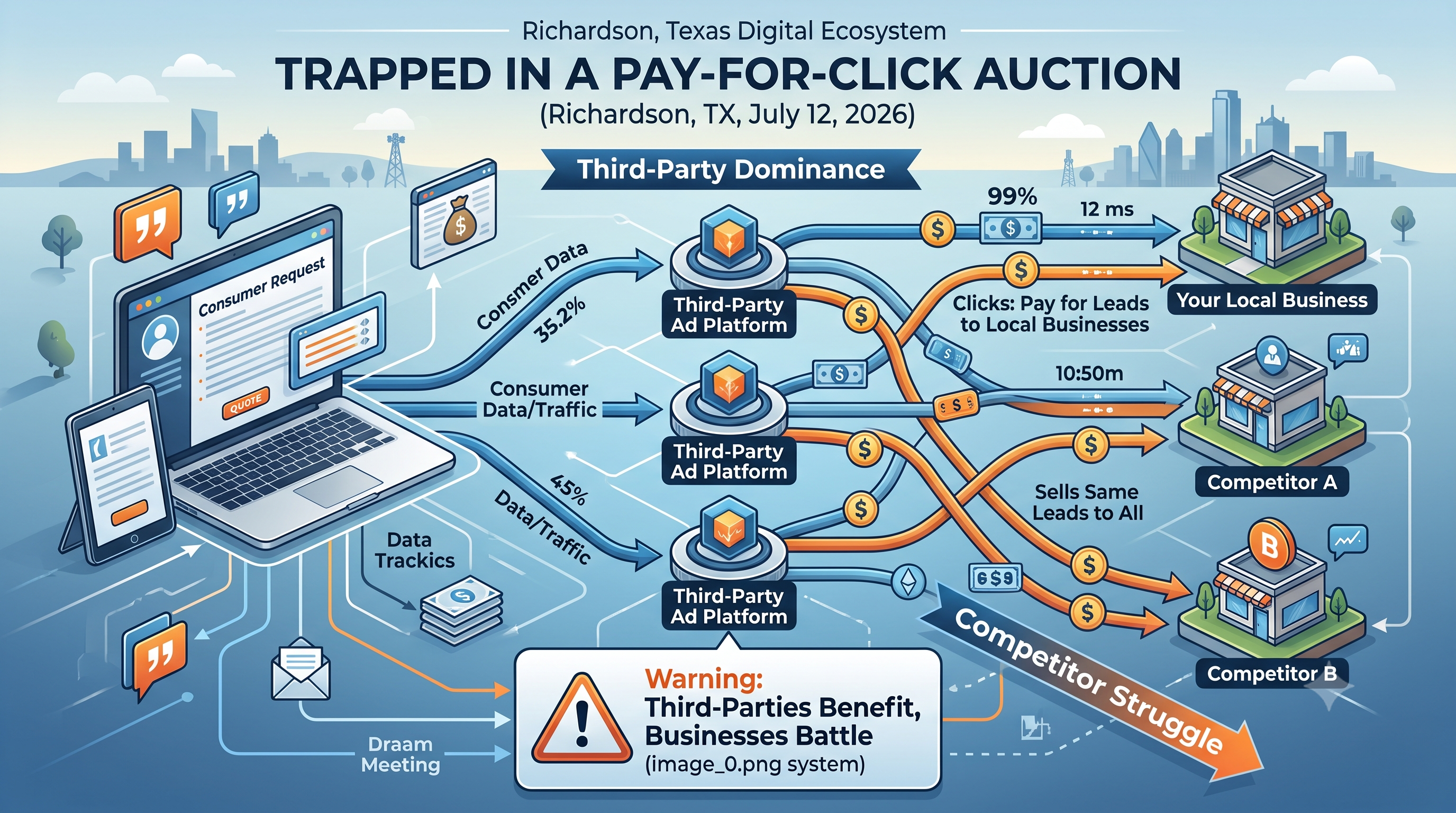
The system prompts the user to select multiple businesses to "compare quotes." The platform takes that single user intent and auctions it off to four or five different local service providers simultaneously.
This triggers a frantic, exhausting race to the bottom. Because the consumer is bombarded with five competing bids within minutes, your service is instantly commoditized. The value of your brand, your execution, and your unique backstory are wiped out. The only metric that matters in this environment is price.
By relying on this model, you are actively participating in your own margin erosion. True wealth mastery and business sustainability cannot exist when your primary client acquisition channel is built on rented, shared, and price-sensitive leads. You must own the pipeline if you want to control the margin.
3. Week 1 Action Plan: The Audit of Dependence
Emancipation does not happen overnight. It requires strategic preparation, technical understanding, and a clear-eyed assessment of your current operational reality.
Before we can help you build your own marketing engine, we must conduct a thorough diagnostic audit of your current digital dependencies. Your mission for Week 1 is to complete these four diagnostic steps:
Step 1: Calculate Your Real Customer Acquisition Cost (CAC)
Do not just look at your monthly Yelp invoice and divide it by the number of "clicks" or "leads" the platform claims it delivered. Dive into your actual customer records for the last 90 days.
How many paying clients actually originated from Yelp?
What was the total dollar amount spent on ads during that period divided by those actual closed sales?
What is your real, bottom-line Customer Acquisition Cost?
Step 2: Map Your Leaking Traffic
Go to your public Yelp profile using an incognito browser window. Look closely at your page. How many competitor banners, alternative recommendations, and sponsored listings are plastering your profile? Document exactly how much of your organic reputation is being used to divert traffic away from your brand to companies that are paying higher ad premiums.
Step 3: Audit Your Sovereign Assets
Take an inventory of the digital properties you actually own and control.
Your Website: Is it a high-converting direct-response funnel, or is it just a static digital brochure?
Your Google Business Profile: Is it fully optimized, verified, and consistently updated to capture organic local search engine optimization traffic?
Your Customer Database: Do you have a structured, functional CRM with your past clients' names, phone numbers, and email addresses, or is your customer data scattered across paper invoices and spreadsheet fragments?
Step 4: The Mindset Shift
The final and most critical step of Week 1 is mental. You must abandon the victim mindset that claims, "I have no choice but to pay them." You have a choice. The tools to build a highly automated, sovereign, self-owned lead generation system are more accessible today than they have ever been in human history.
4. Reclaiming the Engine: The Sovereign Path Forward
The ultimate alternative to renting your audience is building an independent, automated marketing ecosystem.
When you transition away from directories and invest in your own infrastructure—using direct-response local funnels, organic Google local search engine optimization, automated missed-call text-back systems, and private database reactivation campaigns—you change the entire dynamic of your business.
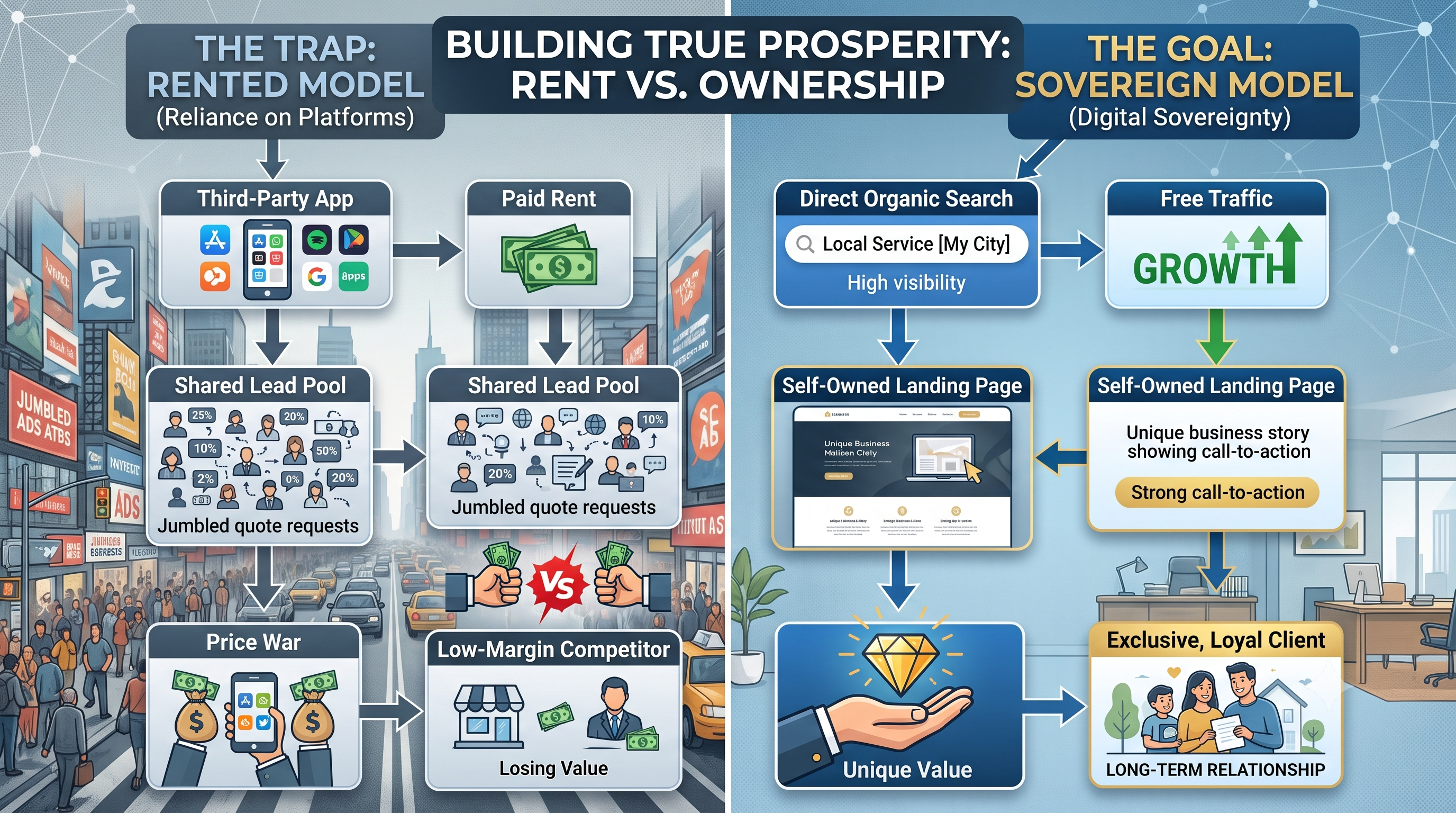
When a customer finds you directly, they are not comparing you to five other bidding wars in a mobile app drop-down. They are engaging with your brand, your media, and your authority. You own the data. You own the relationship. You own the transaction from start to finish.
This is the promise of the Work-From-Home Revolution and the digital systems we build at Evolve Business Systems. We do not believe in paying toll booths to reach our own audience. We believe in building the highway.
What’s Next: Preparing for Week 2
Now that you have recognized the mechanics of the trap and started your Week 1 audit, you are ready to prepare for the physical transition.
In Week 2 of the Yelp Emancipation Project, we are going to dive deep into the technical foundation of your self-owned marketing engine. We will show you exactly how to optimize your Google Business Profile to capture high-intent local traffic organically, and how to set up simple, bulletproof lead-capture mechanics that bypass third-party platforms entirely.
Stop letting third-party corporations dictate the financial health of your enterprise. Complete your audit, take inventory of your sovereign assets, and get ready to take back control of your local lead generation.
The door to the escape hatch is open. It’s time to walk through it.
Join the Revolution
If you are ready to stop renting your business success and start building a high-performance, automated lead engine that you control 100%, subscribe to this blog by commenting below, and follow the Yelp Emancipation series weekly. The tools are here. The frameworks are built. The only missing variable is your decision to execute.
Like this Post? Check out our other articles at